

 En
En  Deutsch
A Professional Springform Pan range reads better as a ladder than as a list. The opening page of the Bake & Bake listing, twelve of the 33 springform products, runs from 18 cm to 28 cm in round pans, with three square pans beside them. Each step on that ladder changes how much batter a Professional Springform Pan holds and how many pans fit in a carton, and both numbers can be worked out from the listing.
The round ladder
The round pans are listed at 18, 20, 22, 24, 26 and 28 cm, all at a depth of 6.8 cm, with inch equivalents printed beside the centimetres. Because the depth is the same, the batter a pan holds follows its floor area, and floor area grows with the square of the diameter. An 18 cm pan has a floor of about 254 square centimetres. A 24 cm pan has about 452, and a 28 cm pan about 616.
Those figures turn into practical ratios. An 18 cm pan holds about 56 per cent of the batter of a 24 cm pan at the same fill height, and a 28 cm pan holds about 36 per cent more. A recipe written for a 24 cm pan and baked in a 26 cm pan spreads over about 17 per cent more floor, so the layer comes out roughly 15 per cent thinner. A buyer of a Professional Springform Pan who knows these ratios can tell customers which size suits a recipe before they bake.
What the base and latch do
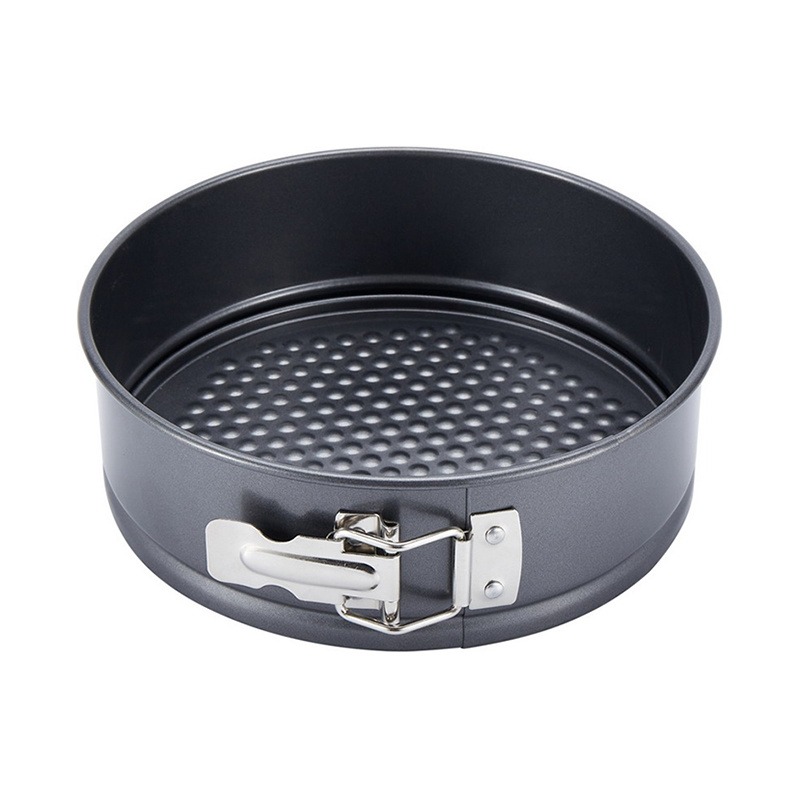
Every Professional Springform Pan has a removable base and an adjustable latch on the side. The listing describes the pans as carbon steel with a food-grade non-stick coating, and it says the spring latch gives a tight seal during baking and allows quick, safe removal after cooling. That arrangement suits cheesecakes, mousse cakes and tortes, which are too delicate to turn out of a standard cake pan.
Many bakers line the removable base with parchment paper, which helps the cake release and keeps clean-up simple. Because the side opens, the cake can stay on the base for serving, and the side can be lifted away once the dessert has set. A Professional Springform Pan is built around that one step: the cake is not turned over.
Carton space across the ladder
Every listed pan ships 12 pieces to a carton. Carton volume rises from 0.031 cubic metres for the 18 cm pan to between 0.06 and 0.063 for the 28 cm pans. Divide by 12 and a single pan takes about 0.0026 cubic metres of carton space at 18 cm and about 0.0053 at 28 cm. The 28 cm pan therefore takes about twice the carton space of the 18 cm pan while holding about 2.4 times the batter.
For a buyer comparing landed cost, that means larger pans carry more baking capacity per cubic metre of freight. A buyer planning a container can use the per-carton volumes to compare sizes on equal terms, and a Professional Springform Pan order can be costed pan by pan instead of by the carton alone.
Square pans beside the round ones
Three square pans sit beside the round ones, listed at 24 by 6.4 cm, 26.5 by 6.8 cm and 27.5 by 6.7 cm. They give a Professional Springform Pan buyer a straight-sided alternative for bar-style cheesecakes and layered desserts that are cut into portions. Their carton volumes of 0.05, 0.054 and 0.063 cubic metres match those of the 24, 26 and 28 cm round pans, so a mixed order of round and square pans is easy to plan. Each of them has the same removable base and side latch as the round pans.
Planning a range
Buyers can read the ladder against their market. The inch equivalents printed beside the centimetres help buyers in both Europe and the Americas, the two markets Bake & Bake names as its main ones. Many European cake recipes are written for 24 or 26 cm springform pans, and those two rungs sit in the middle of the ladder. A Professional Springform Pan range that includes the 24 and 26 cm sizes, plus a smaller and a larger step, covers a wide span of recipes without carrying every rung.
The pans come from the group's own factory, Wuyi Kaifu Bakeware Co., Ltd., and Bake & Bake lists FDA, LFGB, DGCCRF, ISO 14001 and BSCI approvals for its factory and products. A Professional Springform Pan from that factory is listed with its size, its pack count and its carton volume, which gives a buyer every figure needed to build a ladder of its own.
