

 En
En  Deutsch
A non-stick surface that releases food perfectly on a factory sample can start flaking within weeks of daily use if the coating wasn't bonded to the base metal correctly during production. Manufacturing a Cookie Sheet and Roaster Pan line that holds up to repeated retail-shelf-to-kitchen use depends on coating adhesion quality far more than the coating formula itself, which is why buyers comparing suppliers should ask about the bonding process rather than accepting a general "non-stick" claim at face value.
Base Metal Selection Sets the Warping Threshold
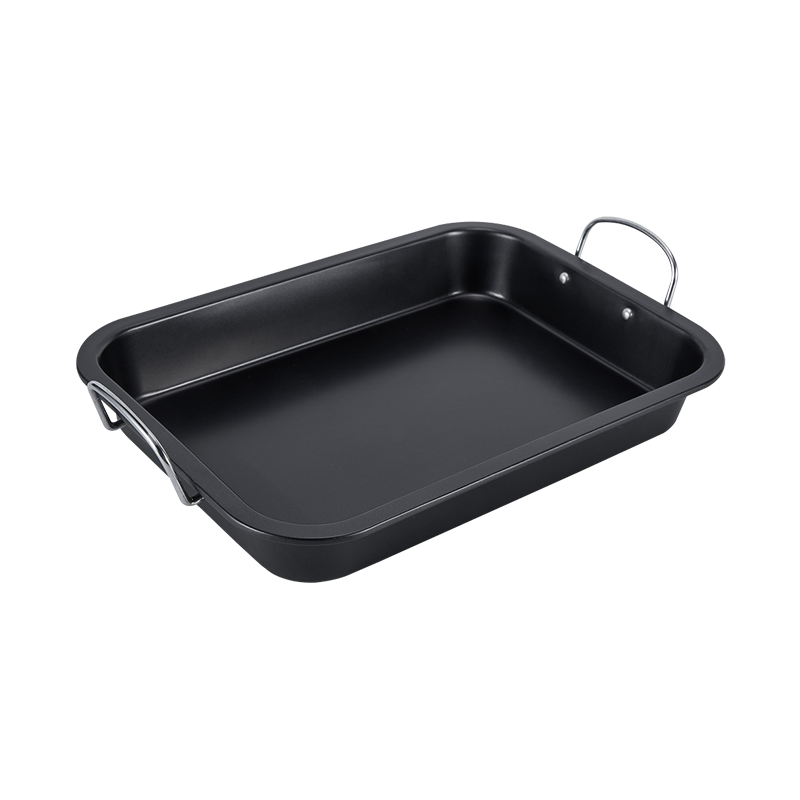
Production of a Cookie Sheet and Roaster Pan typically starts with a choice between aluminized steel and heavier-gauge carbon steel, and this decision affects how the finished product performs under sustained oven heat far more than buyers might expect from a spec sheet comparison alone. Thinner gauge material heats faster but warps more readily under repeated high-temperature cycling, while heavier gauge steel resists warping at the cost of slower, less even heat response. Manufacturing teams building Cookie Sheet and Roaster Pan lines for commercial-duty use typically specify heavier gauge stock and reinforce pan edges with a rolled or folded lip, since this structural detail resists the bowing that thinner flat sheets develop after months of oven cycling.
Coating Application and Curing Process
The non-stick coating on an aluminized steel bakeware line needs to be applied in a controlled thickness and cured at a precise temperature profile, since inconsistent curing creates coating that looks identical on a fresh sample but delaminates at different rates once it enters actual use. Production lines running tight process control test coating adhesion using a cross-hatch or tape-pull method on sample units pulled from each batch, rather than relying solely on visual inspection, since coating that appears smooth and even can still fail an adhesion test if curing temperature drifted during a production run.
Comparing Construction Approaches by Application
|
Construction Factor |
Standard Cookie Sheet |
Deep Roaster Pan |
|
Typical Depth |
1.8–2.5 cm |
3.4–5.5 cm |
|
Primary Use |
Cookies, flat baked goods |
Roasts, casseroles, larger cuts |
|
Edge Reinforcement |
Rolled rim |
Deeper rolled or folded rim |
|
Heat Distribution Priority |
Even flat-surface heating |
Consistent heating through greater depth |
Buyers stocking for retail bakeware sets typically need both a cookie sheet and a roaster pan represented within a single Cookie Sheet and Roaster Pan program, since the two formats serve genuinely different cooking tasks despite sharing similar base materials and coating processes.
Edge Reinforcement Prevents Long-Term Deformation
A reinforced edge pan resists the warping that develops when a flat sheet expands and contracts repeatedly under oven heat, and this reinforcement matters more for larger-format pans where more surface area means more material working against itself during thermal cycling. Manufacturing teams building a Cookie Sheet And Roaster Pan line test reinforced samples through repeated heat-cycling before approving a design for full production, checking that the pan returns to flat after cooling rather than retaining a permanent bow that would cause uneven cooking and rocking on oven racks.
Certification and Quality Control for Export Production
A Cookie Sheet and Roaster Pan destined for export needs food-contact material certification confirming the coating and base metal meet safety standards in the destination market, along with facility-level quality management certification covering the production line itself. Buyers should request batch-specific test documentation rather than a general company certificate, since coating formulation or base metal sourcing can shift between production runs in ways that a single historical certificate wouldn't capture. Colorfastness and coating durability testing under repeated wash cycles matters as much as initial adhesion testing, since a non-stick baking sheet that performs well on day one but degrades after two dozen wash cycles creates return complaints that damage a buyer's retail reputation.
Customization and Bulk Supply for Distributors
Buyers placing bulk orders for a commercial roasting pan program typically request size variations and packaging configurations rather than coating changes, since the coating and base metal specification usually stays fixed across a production run while dimensions and carton packing adjust to the buyer's target market. Confirming carton dimensions and packing density early in sourcing discussions helps buyers plan container loading efficiently, since pan depth directly affects how many units fit per carton and, by extension, total shipping cost per unit.
