

 En
En  Deutsch
A non stick square baking pan may seem like one of the simplest tools in a kitchen. There are no moving parts, complicated settings, or special techniques required to use it.
Yet experienced bakers often pay close attention to one area that many beginners overlook completely:
the corners.
When a batch of brownies, bars, cakes, or baked desserts comes out of the oven, the corners frequently tell a different story from the center. Sometimes they are slightly firmer. Sometimes they brown earlier. Sometimes they become the first pieces people reach for.
The reason has more to do with geometry than recipes.
Corners Receive Heat From More Directions
A round pan and a square pan do not behave exactly the same way in the oven.
With a non stick square baking pan, the corners are exposed to heat from two connecting sides rather than a single continuous curve. This creates slightly different baking conditions compared with the center area.
The effect is usually subtle.
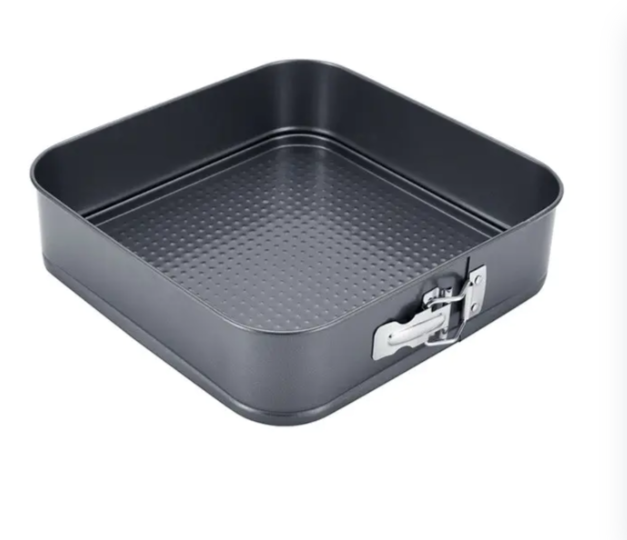
However, when baking dense products such as brownies, cookie bars, or tray cakes, small differences in heat distribution can become easier to notice.
This is one reason recipes that perform perfectly in a round pan may show slightly different characteristics when transferred to a square format.
Some People Actually Prefer The Corner Pieces
An interesting debate exists in many kitchens.
When a dessert is baked in a non stick square baking pan, not everyone wants the center piece.
Some people specifically look for the corners because they enjoy the slightly firmer texture. Others prefer the softer middle sections.
The preference often depends on the type of dessert being prepared.
For brownies, corner pieces frequently develop a different texture profile. For cakes, the contrast may be much less noticeable. The same pan can create different eating experiences within a single batch.
Cutting Is Part Of The Baking Process
Many home bakers think the job is finished once the food leaves the oven.
In reality, cutting often determines how the final product looks.
A non stick square baking pan naturally encourages portioning into uniform shapes, which is one reason it is commonly used for desserts intended for sharing. School events, office gatherings, bake sales, and family celebrations often involve recipes that need consistent portions.
Actually, some bakers choose square pans less because of baking performance and more because of what happens afterward.
Straight edges make planning portions surprisingly simple.
Release Problems Often Start At The Edges
One reason people choose a non stick square baking pan is the expectation of easier release.
Interestingly, when sticking occurs, it often appears near corners or along edge transitions rather than across large flat surfaces.
Tiny amounts of batter can settle into these areas during baking. If preparation is inconsistent, those locations sometimes become the first places where removal becomes difficult.
Experienced bakers therefore tend to pay attention to corners long before the baked product is ready to come out.
The final release often depends on preparation done at the beginning.
Cooling Looks Different In A Square Pan
A non stick square baking pan also creates a cooling pattern that many bakers eventually learn to recognize.
The outer edges usually begin changing temperature before the center. Depending on the recipe, this can influence texture, slicing behavior, and handling after baking.
For some desserts, waiting an extra few minutes before cutting can make a noticeable difference.
This is why experienced bakers often watch the cooling process as carefully as they watch the baking process itself.
The oven may be off, but the dessert is still changing.
The Shape Influences More Than Appearance
At first glance, a non stick square baking pan seems defined by its shape.
Yet that shape quietly affects heat movement, portioning, texture variation, cooling behavior, and even how people choose their favorite piece.
Many recipes can be adapted to different pans.
The interesting part is how the experience changes once the dessert is baked.
Sometimes the corner piece becomes the most popular one on the tray.
And sometimes that happens because of the pan long before anyone takes the first bite.
